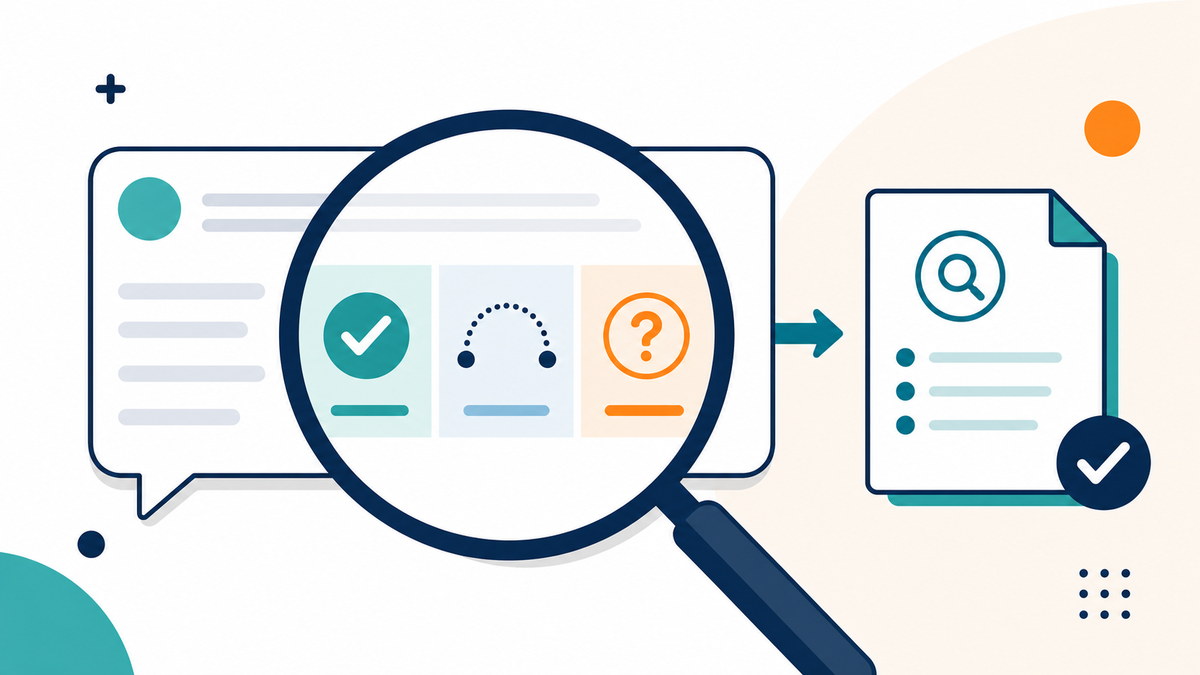
TL;DRAI confidence is not evidence ask where the answer came from, expose what is missing, and verify the consequential claim using an independent source.
Here is the most important limitation of the method in this article:
An AI cannot serve as the independent verifier of its own answer.
You can ask it to identify sources, label assumptions, and admit uncertainty. Those steps make unsupported claims easier to notice.
They do not transform the AI into a fact-checker.
A model can confidently invent a fact. It can also invent a citation, misread a real source, or incorrectly label its own inference as supported.
The final check still belongs to you.
Why Guessing Sounds Convincing
Producing fluent language is part of what AI tools are designed to do. A correct answer and a completely invented answer can therefore arrive in the same polished tone.
OpenAI's research article Why Language Models Hallucinate describes hallucinations as plausible but false statements and argues that common evaluations can reward guessing rather than admitting uncertainty. The NIST Generative AI Profile uses the term confabulation for confidently presented false or erroneous content.
Sources: openai.com/index/why-language-models-hallucinate/ and nist.gov/publications/artificial-intelligence-risk-management-framework-generative-artificial-intelligence
You do not need to understand the training process to protect yourself.
Use the SURE check.
S — Find the Source
Ask:
Where did this claim come from?
Possible answers include:
- information you supplied;
- an attached document;
- a webpage the tool accessed;
- general patterns learned during training;
- an inference;
- or an unsupported generation.
Those are not equally trustworthy.
If the AI refers to a document, ask it to identify the supporting section. Then read the section yourself.
If it provides a link, open it. Check that the page exists, is authoritative enough for the question, and actually supports the claim.
For current prices, schedules, policies, officeholders, or software instructions, confirm that the source is current. A remembered answer may already be obsolete.
U — Expose the Uncertainty
Ask the AI to separate:
- facts stated directly in the source;
- reasonable inferences;
- missing information;
- and claims requiring outside verification.
Give it explicit permission to write “not stated” or “I cannot determine that from the supplied information.”
That will not guarantee honesty. It reduces the pressure to manufacture a complete-looking answer.
Uncertainty is often more useful than false precision.
R — Check the Reach
Ask whether the available evidence can actually support the conclusion.
A fixed document may answer:
- What date appears in this notice?
- Which requirements are listed?
- Does the policy mention sale items?
The same document may not answer:
- Is this still the current policy?
- Will the organization make an exception?
- Is this the best choice for me?
- Is this appropriate medical, legal, or financial advice?
When the question reaches beyond the evidence, the answer should be treated as an inference until checked elsewhere.
E — Examine the Important Claim Independently
Do not ask the AI to perform this final step for you.
Use the original document, an official website, a qualified person, or another primary source that does not depend on the AI’s answer.
You do not need to verify every sentence. Focus on the detail that could change your action:
- a deadline;
- an amount;
- an eligibility rule;
- a product specification;
- a quotation;
- an address;
- or the factual premise behind a recommendation.
The higher the consequence, the stronger the independent check should be.
A Simple Example
Imagine a fictional store policy says:
Returns are accepted within 30 days of delivery when the item is unused and the receipt is included. Personalized items cannot be returned.
You ask:
Can I return a sale item after 45 days?
A supported answer can say:
- the stated return period is 30 days;
- 45 days is outside that period;
- the policy does not state whether sale items receive different treatment;
- and an exception would need to be confirmed with the store.
A guessing answer might confidently claim that sale items receive a 60-day return period.
That detail sounds helpful. Nothing in the supplied policy supports it.
The SURE check should identify the unsupported claim. Only the store’s current official policy or an authorized representative can verify the actual rule.
Copy This Prompt
Help me inspect this information, but do not treat your own output as independent verification.

Use only the material I provide below unless you clearly identify an external source you actually accessed.

Return four sections:

1. Supported facts — stated directly in the supplied material.
2. Inferences — reasonable possibilities that are not stated directly.
3. Unknowns — questions the material cannot answer.
4. Verification plan — the important claims I should check independently and the primary sources I should use.

If information is missing, write “not stated.”

Do not invent a date, name, rule, quotation, source, or numerical detail. Do not claim that your labels prove the answer is correct.

Material:
[Paste a public or privacy-safe excerpt here.]
Remove names, account details, addresses, private messages, medical information, and confidential material before pasting anything into an AI tool.
Five Warning Signs
An answer needs extra checking when:
- It gives an exact date, number, quotation, or source without showing where it came from.
- The linked source does not support the claim.
- The answer changes materially when the same factual question is asked again.
- It fills a gap instead of saying the information was not provided.
- It makes a current claim without accessing a current source.
These signs do not automatically prove that an answer is wrong. They identify where verification matters most.
When AI Should Not Be the Final Check
Do not rely on an AI answer alone for medical care, mental health, legal rights, taxes, investments, personal safety, emergencies, or another high-stakes matter.
AI can organize information, simplify unfamiliar language, and help prepare questions. It should not be the final authority.
For an ordinary question, the SURE check takes only a few minutes:
- Source: Where did this come from?
- Uncertainty: What is missing or inferred?
- Reach: Can the available evidence support the conclusion?
- Examine: Which claim will I verify independently?
The goal is not to make AI infallible. It is to notice when a fluent answer is asking for more trust than its evidence deserves.